
How Long do Garage Floor Coatings Really Last?
Use our quick contact form to get in touch with our team. We respond within 24 hours.
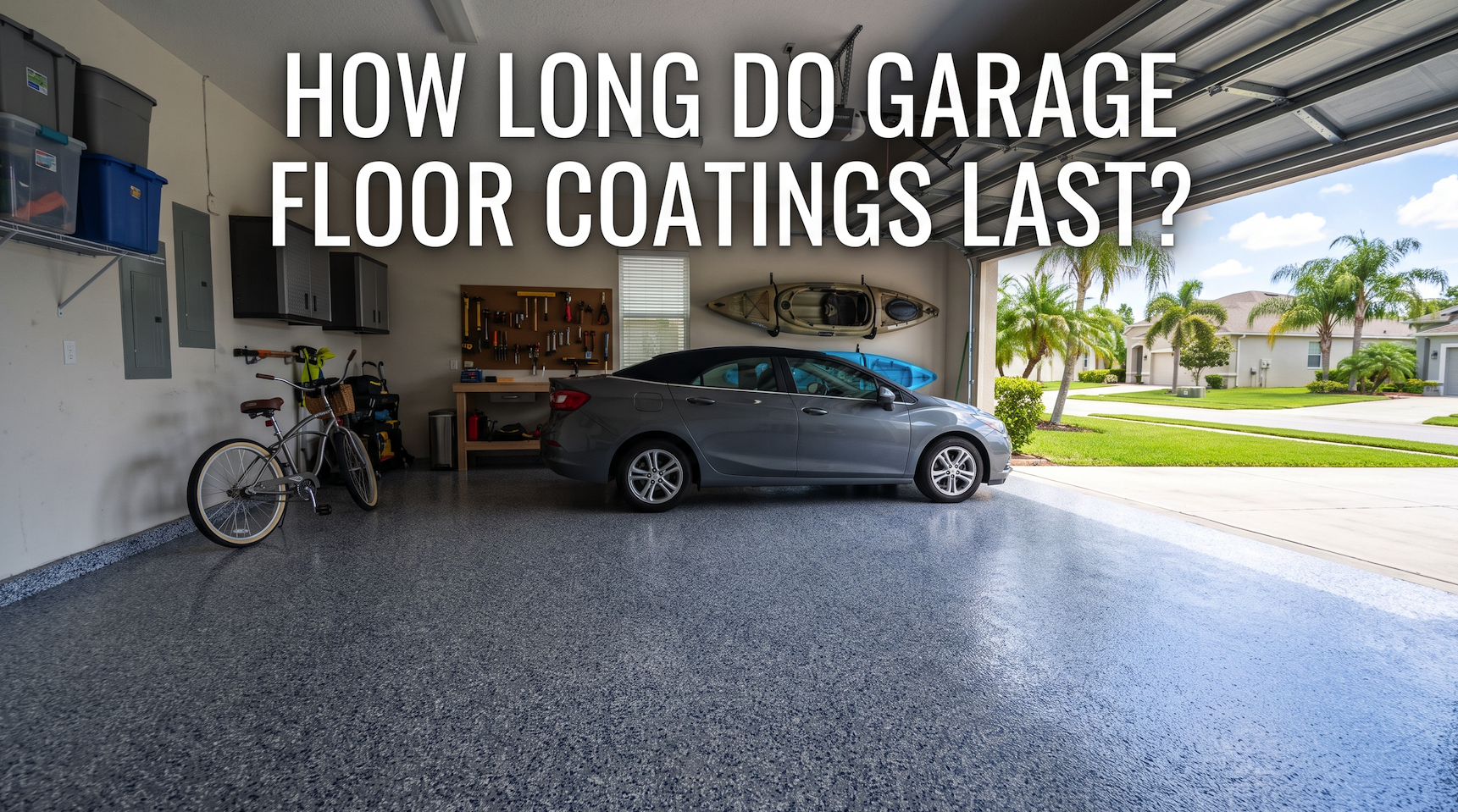
How Long Does Garage Floor Coating Last? Durability Depends on Installation, Not Just Product Choice
Professional garage floor coatings last 10 to 20 years when installed correctly, with polyurea and polyaspartic systems typically outlasting standard epoxy. However, longevity depends less on the product you choose than on whether your contractor addresses moisture vapor transmission, achieves proper mechanical adhesion through diamond grinding, and applies adequate mil thickness - factors that separate a cosmetic finish from an engineered system. Most articles about garage floor coating lifespan focus entirely on product comparisons - epoxy versus polyurea versus polyaspartic - as though the chemistry alone determines how long your floor lasts. That framing misses what actually drives durability in residential applications: the installation process itself. Over 15,000 garage projects since 2008 have shown us that a properly prepared concrete slab with the right primer system matters more than whether you selected the premium coating or the mid-tier one. The more useful question isn't "how long does this product last?" but rather "should my garage floor investment evolve as my needs change?" Many homeowners return to upgrade their garage in stages - adding overhead storage two years after the floor coating, installing cabinets when the workshop expands, or converting the space from vehicle storage to a home gym. Understanding how your garage functions today versus two years from now affects whether you need maximum durability or a more flexible solution that can adapt as your space evolves.
What Actually Determines Coating Longevity
The industry standard answer - that epoxy lasts 5 to 10 years while polyurea systems reach 15 to 20 years - collapses the moment you account for installation variables. We've replaced three-year-old polyurea floors that peeled because the installer skipped moisture mitigation, and we've seen twelve-year-old epoxy coatings still performing well because the original contractor invested in proper surface preparation.
- Moisture Vapor Transmission
- Concrete slabs release water vapor year-round, particularly in humid climates. Without a moisture vapor barrier primer, coatings delaminate from below regardless of their advertised durability. The ALLPRO specification requires moisture content below 4% before coating - a threshold most DIY moisture tests cannot accurately measure.
- Mechanical Adhesion
- Diamond grinding creates a profiled surface that allows chemical bonding between coating and concrete. Acid etching - the method packaged with most DIY kits - opens the concrete pores but doesn't achieve the same mechanical interlock. Gatorhoops wrote in a review about EZ Garage Solutions: "My builder agreed to epoxy my garage just before closing a year ago due to excessive cracking. He rushed the job...not filling in cracks and used what appeared to be a home depot quality kit. In less than a year, the crack bubbled the epoxy floor and it lifted off." That failure wasn't about the coating chemistry - it was about preparation shortcuts that guaranteed delamination.
- Mil Thickness and Coverage
- A coating applied too thin provides inadequate protection regardless of its chemical composition. Rust-Oleum specifies 16 mils dry film thickness for their high-traffic epoxy system, covering 100 square feet per gallon at that thickness. DIY kits often stretch coverage to 300 or 400 square feet per gallon, reducing the effective coating thickness by two-thirds.
The Prep-to-Product Ratio
Every coating system - epoxy, polyurea, polyaspartic - requires the same foundational steps before application. We diamond-grind every slab to remove surface contaminants and create mechanical tooth. We apply a moisture vapor barrier primer to prevent subsurface delamination. We repair cracks and fill control joints to prevent telegraph cracking through the topcoat. Only after completing these steps does the choice of base coat chemistry become relevant to long-term performance. The cost structure reflects this reality. For our polyurea flooring installations, diamond profiling, crack repair, base coat, decorative flake layer, and polyurea topcoat all factor into the $6.00 per square foot starting price. The coating material itself represents perhaps 30 percent of that total - the preparation work and application expertise constitute the majority of the investment.
How Climate and Usage Patterns Accelerate Wear
Two identical coating systems installed on the same day will age differently depending on garage usage and environmental exposure. The factors that reduce lifespan have less to do with the coating's chemical resistance and more to do with whether its physical properties match the stress conditions it faces daily.
Temperature and Humidity Cycling
Garage floors in humid climates experience constant expansion and contraction as concrete absorbs and releases moisture.
ALLPRO requires ambient temperatures between 59°F and 86°F with relative humidity below 85% during application precisely because conditions outside that range compromise curing. Once cured, the coating still flexes with temperature swings - but a coating applied during poor conditions never develops full tensile strength to handle that flex. Daniel Arnold wrote about a pool deck installation: "I had some concerns after the initial application, but it wasn't their fault (all weather related). They've been out literally 4 times, fighting the rain forecast each trip, to get everything perfect." Weather isn't just an installation inconvenience - it directly affects whether the coating achieves its specified physical properties.
Traffic Type Matters More Than Traffic Volume
A garage used exclusively for vehicle parking presents a different stress profile than one functioning as a home gym or workshop. Hot tire pickup - where rubber compounds bond to the coating surface and pull away during vehicle movement - damages standard epoxy regardless of how thick you apply it. Chemical spills from automotive fluids, paint thinners, or lawn equipment fuels test different resistance properties than simple abrasion from foot traffic. We often see homeowners choose a coating tier based on their garage's current function, then expand usage two years later without considering whether the floor system can handle the new demands. The workshop hobbyist who drops hand tools occasionally needs less impact resistance than someone rolling a loaded toolbox across the floor daily. Neither usage pattern is wrong, but matching the coating system to actual - not imagined - usage prevents premature failure.
UV Exposure and Discoloration
Epoxy coatings yellow when exposed to direct sunlight, a cosmetic issue that doesn't affect performance but bothers homeowners who expected the color to remain stable. Polyurea and polyaspartic formulations include UV inhibitors that prevent this discoloration. If your garage door stays open frequently or large windows admit direct sun, UV stability becomes a practical concern rather than a premium feature. The performance difference isn't about durability in the structural sense - the yellowed epoxy still protects the concrete. But many homeowners interpret discoloration as coating failure and seek replacement long before the floor's functional lifespan ends. Choosing a UV-stable system from the start avoids that perception problem.
Comparing System Longevity Across Coating Types
The chemistry differences between epoxy, polyurea, and polyaspartic systems create distinct performance profiles, but those differences only matter after installation quality equalizes. A poorly installed polyurea floor fails faster than a well-installed epoxy one.
- Standard Epoxy Coatings
- Lifespan: 5 to 10 years with proper installation
Cure Time: Thisoldhouse reports seven days before vehicular traffic
Best Use: Light-duty residential garages with minimal chemical exposure and controlled temperature conditions
Limitations: Yellows under UV exposure, vulnerable to hot tire pickup, limited flexibility in temperature extremes - Polyurea Systems
- Lifespan: 15 to 20 years when properly installed
Cure Time: 24 to 36 hours before vehicular traffic
Best Use: High-traffic garages, workshops, spaces with frequent chemical exposure
Advantages: UV-stable formulation prevents yellowing, superior tensile strength handles thermal expansion, faster cure time reduces installation disruption - Polyaspartic Coatings
- Lifespan: 15 to 20 years, similar to polyurea
Cure Time: Laticrete PERMAGUARD MAX allows vehicular traffic in 24 to 36 hours
Best Use: Installations requiring rapid turnaround or extreme temperature flexibility
Advantages: Can be applied in wider temperature range, excellent abrasion resistance, maintains gloss longer than epoxy
The DIY Kit Reality Check
DIY epoxy kits available at hardware stores cost between $150 and $300, while professional installation runs $4 to $7 per square foot for labor and materials combined. That price gap tempts many homeowners to handle installation themselves, but DIY kits make critical compromises that shorten lifespan:
- Acid Etching Instead of Grinding: Most kits include muriatic acid for surface preparation rather than requiring mechanical grinding equipment. Etching opens concrete pores but doesn't create the profile depth needed for durable adhesion.
- Water-Based or Solvent Epoxy: Thisoldhouse lists water-based epoxy kits at $30 to $50 per gallon and solvent-based versions at $50 to $100 per gallon, compared to 100% solid epoxy at $75 to $150 per gallon. The lower-cost formulations contain less actual epoxy resin, reducing film thickness and durability.
- No Moisture Mitigation: DIY instructions rarely address vapor transmission testing or primer application. The concrete may feel dry to the touch while still releasing moisture that will eventually delaminate the coating from below.
- Insufficient Working Time: Thisoldhouse notes many epoxies have a pot life of just 2 to 2½ hours. An inexperienced applicator working alone cannot prepare, mix, and roll a two-car garage floor within that window, leading to uneven coverage or partially cured material.
Craig Quinn wrote in his review: "2 years ago we put in a few monkey bars. Continued that this week and had to redo the floor due to having it originally done by a painter." The skill gap between general contractors and specialized coating installers appears in subtle preparation details that only reveal themselves months after installation.
When to Prioritize Flexibility Over Maximum Longevity
The assumption that longer-lasting always means better value breaks down when you consider how garage usage evolves. A coating system rated for 20 years makes sense if your garage function will remain stable - vehicle storage today, vehicle storage in 2044. But many homeowners cycle through different uses as their households change: workshop phase during home improvement projects, fitness equipment during health kicks, seasonal storage as family size fluctuates. Building your garage upgrade as a phased investment rather than a single permanent installation changes the calculation. If you install overhead storage racksthis year and plan to add cabinetry in two years when budget allows, you'll need floor access for installation work. A coating system that handles moderate traffic for five to seven years might serve better than one engineered for two decades, particularly if you'll reassess your storage layout before that maximum lifespan arrives.
The Consultative Assessment Model
Before specifying a coating tier, we walk through actual usage patterns rather than assumed ones. How many vehicles park in the space overnight? Do you work on cars, or just store them? What chemicals or fluids might spill? How often does the garage door stay open? Do you plan to add cabinets, ceiling racks, or other systems within the next three years? Those answers determine whether you need the full commercial-grade system or whether a mid-tier residential coating delivers sufficient durability for your timeline. A home gym enthusiast dropping dumbbells occasionally needs impact resistance. A vehicle storage garage in a climate-controlled environment can use a less robust system. Neither choice is wrong - the match between system and use case determines value.
Cost Structure and Return on Investment
For a standard two-car garage of 400 square feet, our polyurea flooring averages $2,400 installed, including diamond profiling, crack repair, moisture vapor barrier primer, decorative flake layer, and topcoat. That investment amortized over 15 years costs $160 annually. Standard epoxy at lower initial cost but seven-year lifespan requires replacement twice during that same period, often at higher total expense once you account for the need to remove the failed coating before reapplying. The return on investment calculation changes if your garage function will shift before either coating reaches end-of-life. Installing cabinetry three years from now means the floor takes mounting hardware for cabinet bases. Adding ceiling racks requires ladder access and potential surface protection during installation. Those interventions don't damage a well-installed floor, but they do introduce new stress points that weren't part of the original use case. Dani fw wrote: "1st project was at another home over 8 yrs ago (polyurea decking & wall mounted storage cabinets w/workbench)." The integration between flooring and other garage systems matters more than product specifications in isolation. Thinking through the complete space plan before committing to a coating tier prevents overbuilding for needs you don't have or underbuilding for demands that arrive sooner than expected.
Recognizing Coating Failure Before It Becomes Structural
Most coating failures announce themselves gradually rather than catastrophically. Recognizing early-stage problems allows repair or recoating before damage extends into the concrete substrate itself, which costs significantly more to remediate than addressing a surface-level coating issue.
- Edge Peeling: Delamination typically starts at garage door thresholds, control joints, or perimeter edges where moisture penetration finds the easiest path. Small lifted areas expand as water intrusion continues beneath the coating.
- Bubbling or Blistering: Raised areas indicate moisture vapor pushing up from below. This happens when vapor transmission wasn't addressed during installation or when the moisture barrier primer failed. The bubbles will continue spreading until the coating delaminates entirely.
- Hot Tire Marks: Rubber compounds bonding to and pulling away from the coating surface indicate the topcoat has softened, usually from insufficient cure time before vehicular traffic or from using a coating formulation not rated for thermal cycling from hot tires.
- Color Fading or Yellowing: Epoxy systems yellow under UV exposure as their chemical structure breaks down. This is cosmetic rather than structural, but indicates the coating has reached the point where it no longer provides the appearance you paid for.
- Surface Scratching or Scuffing: Excessive wear in high-traffic areas shows the coating has worn through to lower mil thickness. Once abrasion reaches the base coat, chemical resistance and moisture protection decline rapidly.
We use a moisture vapor barrier epoxy primer on every installation precisely to prevent the subsurface failures that appear months after application. The primer costs more and adds a layer most DIY approaches skip, but it's the difference between a coating that lasts its rated lifespan and one that delaminates prematurely.
The Maintenance Habits That Extend Lifespan
Even commercial-grade coatings degrade faster without basic maintenance. These practices cost nothing and significantly extend the functional life of any coating system:
- Clean Spills Immediately: Automotive fluids, battery acid, and lawn chemicals damage coatings through prolonged contact. Wiping spills within minutes prevents chemical etching that compromises the surface.
- Avoid Abrasive Cleaning: Metal scrapers, wire brushes, and abrasive powders scratch topcoats and expose lower layers to moisture and chemical penetration. A deck brush with mild detergent removes most stains without damaging the coating.
- Control Temperature Extremes: Allow vehicles to cool before parking if possible. Hot tire pickup occurs when rubber compounds soften and bond to coating surfaces above certain temperatures. Letting exhaust systems and brake components cool for ten minutes reduces this risk.
- Inspect Joints and Edges Annually: Check control joints, perimeter edges, and door thresholds for small lifted areas. Addressing edge peeling when it covers a few square inches prevents water intrusion that spreads delamination across the entire floor.
- Reapply Topcoat as Needed: High-traffic paths and work areas wear through topcoats before base coats fail. Reapplying just the topcoat in affected areas costs a fraction of complete floor replacement and extends total system life by years.
Cammie Thomas wrote: "They did our garage floor a few years ago and it still looks great." That durability comes partly from coating quality but equally from maintenance habits that prevent accelerated wear. The investment in professional installation earns its return only when homeowners protect that investment through basic care.
The marketing language around garage floor coatings emphasizes product specifications - tensile strength, abrasion resistance, chemical ratings - as though selecting the right chemistry guarantees results. Eighteen years installing floors in the greater Jacksonville area have taught us those specifications matter far less than whether the installation process addresses the substrate conditions, moisture environment, and usage demands specific to your garage. Choosing a coating system should start with a consultative assessment of how you use your garage today and how that might evolve. Do you need maximum durability because the space functions as a workshop with heavy equipment? Or does your usage pattern suggest a mid-tier system that delivers sufficient performance for a five-to-seven-year timeline, after which you'll reassess your storage layout and potentially upgrade other garage systems? Neither answer is wrong. What matters most to you changes depending on whether you're building a permanent solution or investing in a flexible system that adapts as your household needs change. At EZ Garage Solutions, we've completed over 15,000 garage transformations since 2008, most within one to two days including cleanup. Our process - diamond grinding, moisture vapor barrier primer, crack repair, base coat, decorative flake layer, and topcoat - remains consistent regardless of which coating chemistry you select, because longevity depends on that foundation rather than the product name on the bucket. Call (904) 887-9395 or reach out through our contact form, and we'll walk through your garage's actual usage patterns to determine which system matches your timeline and budget rather than pushing the highest-margin product.


