
How Long do Garage Floor Coatings Really Last in Florida's Humidity-Driven Climate?
Use our quick contact form to get in touch with our team. We respond within 24 hours.
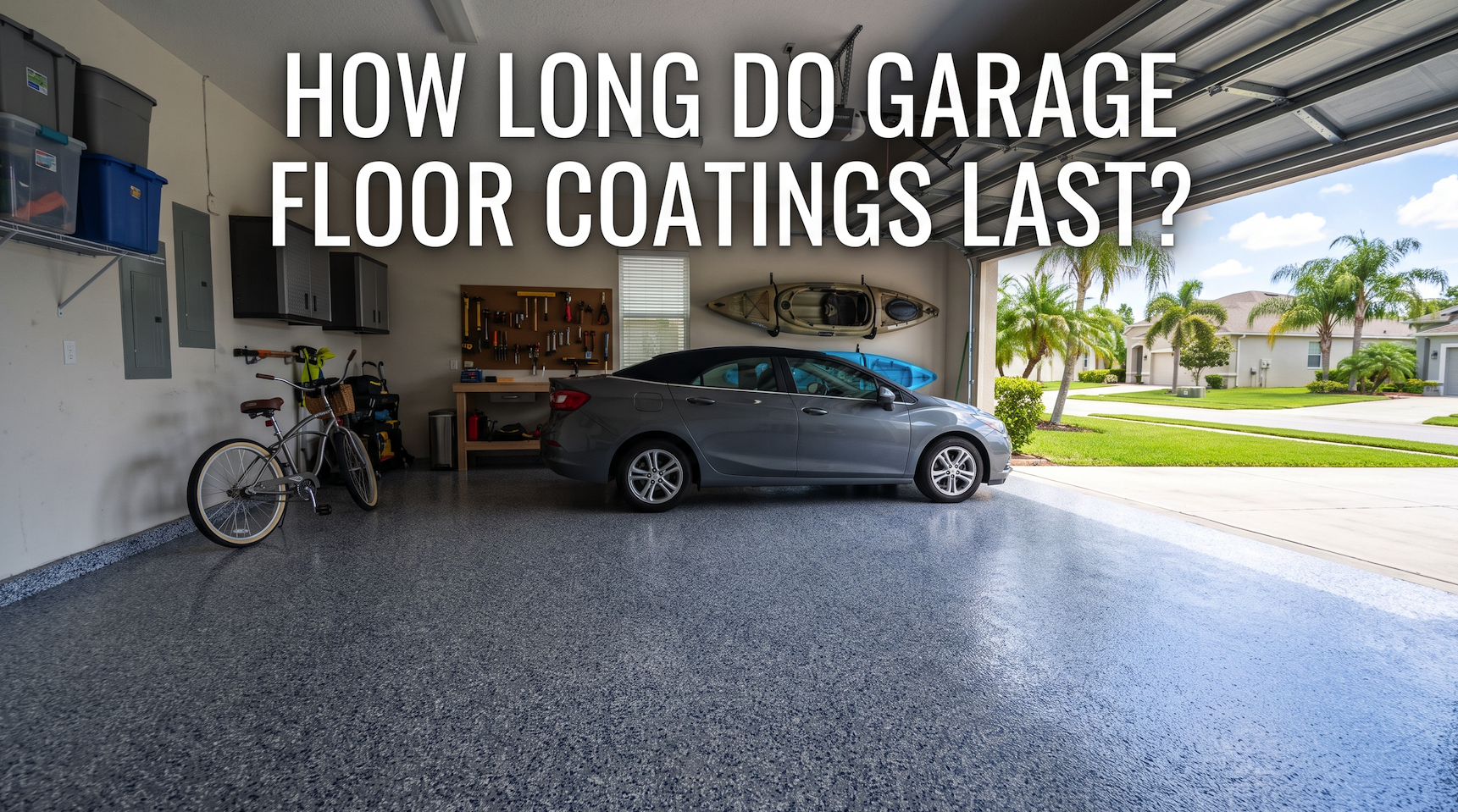
How Long Does Garage Floor Coating Last in Florida's Humidity-Driven Climate
Professional-grade polyurea and epoxy garage floor coatings last 10 to 20+ years in Florida when installed over mechanically profiled concrete with a moisture vapor barrier primer. Longevity depends more on substrate preparation and humidity mitigation than coating chemistry alone - surface failures typically originate at bond lines where moisture infiltration compromises adhesion, not from wear-through of the coating itself.
Why Florida's Climate Compresses Coating Lifespan More Than Traffic Wear
Every garage floor coating conversation in North Florida eventually circles back to the same question: how many years will this actually last? The honest answer depends less on the coating's abrasion rating than on whether the installer addressed the durability factors unique to this region.
Florida's year-round humidity creates a durability equation most national coating specifications never anticipated. Moisture vapor transmission through concrete slabs remains active even in climate-controlled garages, driven by hydrostatic pressure from below and humidity cycling from above. When that vapor reaches the coating interface without a barrier system in place, it lifts the bond at perimeter edges first - the exact failure pattern we've documented hundreds of times when replacing DIY epoxy jobs that delaminated within 2 years.
Thermal cycling compounds the problem. A concrete slab in direct sun routinely hits surface temperatures above 140°F by mid-afternoon, then drops 60 degrees overnight. That expansion-contraction cycle stresses every bond line in the system. Coatings applied over acid-etched concrete - where surface profiling barely exceeds 0.5 mils - simply don't have enough mechanical interlock to withstand the lateral forces generated by two decades of daily thermal movement.
The moisture issue extends beyond the floor itself. In most attached garages, the shared wall with conditioned living space acts as a condensation plane during summer months when humid outdoor air meets the cooler interior wall surface. Water migrates down that wall and pools along the floor perimeter, soaking into the exposed concrete edge. A floor coating that stops at the slab creates an unprotected pathway for moisture to wick underneath the coating from the sides, attacking the bond line where it's most vulnerable.
Why Wall Coating Creates a Unified Moisture Barrier
Coating the garage side walls in addition to the floor creates a continuous moisture barrier that protects the floor coating's perimeter bond lines. When polyurea extends 6 to 12 inches up the wall surface, moisture traveling down from condensation points cannot reach the floor edge where delamination typically originates. This integrated approach treats the garage as a unified moisture zone rather than isolating the floor as a separate system.
We've installed this wall-to-floor transition on every garage transformation since 2015, and the difference in edge integrity is measurable. Floors installed with perimeter wall protection show no edge lift even in homes backing onto retention ponds where vapor drive stays elevated year-round. The same coating chemistry applied to the floor alone, without wall protection, routinely shows perimeter bubbling within 3 years in identical moisture conditions.
Mechanical Preparation vs. Chemical Etching: The Twenty-Year Difference
Surface preparation determines whether a coating lasts 2 years or twenty, yet it remains the single most common cost-cutting measure in the industry. The preparation method creates the physical anchor that holds everything else in place.
Diamond grinding removes surface laitance and creates a mechanical profile between 1 and 3 mils deep - enough texture for the primer to key into the concrete pore structure. The diamond abrasive opens capillaries without introducing chemical contaminants that might later interfere with adhesion. Every manufacturer specification sheet for professional garage floor coatings lists mechanical profiling as the minimum acceptable preparation standard, typically citing ICRI CSP-2 or CSP-3 profiles.
Acid etching creates a surface texture through chemical dissolution rather than mechanical abrasion. The resulting profile rarely exceeds 0.5 mils, and the etching process leaves behind salts that can interfere with coating adhesion if not completely neutralized and rinsed. More critically, acid does nothing to remove surface oils, tire rubber deposits, or curing compounds - the three most common bond inhibitors in residential garages.
The performance gap shows up in pull-off adhesion testing. According to ALLPRO, properly prepared epoxy systems achieve adhesion exceeding 300 PSI with 100% concrete failure - meaning the concrete itself fractures before the coating releases. Acid-etched surfaces rarely exceed 150 PSI in field testing, and failure occurs at the coating-concrete interface rather than within the substrate.
Cal Peters wrote in his review about EZ Garage Solutions: "Sam, Ryan, and Steve used a diamond grinder to remove the black gunk from the floor and prep it to be finished. By the end of the first day, I had a brand new garage floor in the color I wanted with a hard protective coating over it." That black residue - tire plasticizer, oil drips, and embedded rubber - comes off only through mechanical abrasion. Chemical etching just seals it under a thin layer of texture.
Moisture Vapor Barrier Primer: The Coating Layer Nobody Sees
The coating you walk on is not the coating doing the heavy lifting. In Florida's high-vapor-drive environment, the primer layer determines whether the system survives contact with reality.
Standard epoxy primers allow moisture vapor to migrate through the film at rates sufficient to cause delamination when vapor drive exceeds 4 pounds per 1,000 square feet per 24 hours. According to ALLPRO, concrete slabs should test below that four-pound threshold before standard systems are applied - a specification most Florida garages fail during summer months when ground saturation peaks.
We use a moisture vapor barrier (MVB) epoxy primer on every installation because it creates a chemical barrier that blocks vapor transmission rather than merely slowing it. The MVB primer contains reactive silicates that penetrate into the concrete pore structure and create a crystalline barrier layer below the surface. Vapor attempting to migrate upward encounters a physical obstruction rather than just increased resistance.
The performance difference is dramatic in slabs-on-grade with no vapor retarder beneath them - common in homes built before 2000. We've seen MVB-primed floors remain fully bonded in garages testing at 8 pounds of vapor drive, double the threshold where standard systems fail. The investment in barrier primer costs roughly $0.75 per square foot in materials but eliminates the single most common cause of premature coating failure in this climate.
Coating Chemistry: Polyurea vs. Epoxy Longevity Under UV and Thermal Stress
Once moisture and adhesion are controlled, coating chemistry determines how the visible surface performs over time. The two dominant systems differ primarily in how they respond to Florida's UV exposure and thermal cycling.
Epoxy coatings cure through an exothermic reaction between resin and hardener, creating a rigid thermoset polymer. According to ALLPRO, 100% solids epoxy systems achieve a Shore D hardness of 85-90 and tensile strength reaching 6,500 PSI after 7 days of cure. That rigidity delivers excellent abrasion resistance - testing shows only 100 mg loss after 1,000 cycles under ASTM D4060.
The rigidity becomes a liability under thermal stress. Epoxy's low elongation - just 6 to 7% - means it cannot flex with the concrete substrate during expansion-contraction cycles. In garages with western sun exposure, that inflexibility leads to micro-cracking along stress concentration points after 5 to 8 years of daily cycling. The cracks telegraph through decorative flake topcoats as hairline fissures that trap dirt and eventually widen into delamination zones.
UV stability presents another limitation. Epoxy yellows when exposed to direct sunlight, a cosmetic issue in garages with windows or frequent door-open time. The yellowing doesn't compromise structural performance but shifts gray tones toward amber and makes white flake appear cream-colored after 3 to 5 years of exposure.
Polyurea and polyaspartic coatings cure through a different reaction pathway that produces a flexible polymer with UV-stable chemistry. Laticrete specifies that polyaspartic systems like PERMAGUARD MAX contain 99% solids by volume and cure to 100% solids, creating a film with virtually no solvent release after application. The chemistry remains color-stable under UV exposure indefinitely.
Flexibility matters more than hardness in thermal cycling environments. While polyurea may test slightly softer than epoxy on Shore D scales, its ability to elongate and recover prevents the micro-cracking that degrades epoxy systems over time. In installations we completed over 8 years ago, polyurea floors show no cracking even in garages where summer surface temperatures routinely exceed 150°F.
The cure speed presents both advantage and constraint. According to Laticrete, polyaspartic systems reach foot traffic readiness in 12 to 18 hours and vehicular traffic readiness in 24 to 36 hours, compared to 5 to 7 days for epoxy. That speed compresses the installation window but requires precise application - errors cannot be back-rolled out once the chemical reaction begins.
Disposable Floor Solutions vs. Permanent Infrastructure Homeowners Build Around
The longevity question becomes more complicated when you consider what homeowners typically do after installing a floor coating. A coating expected to last 3 to 5 years gets treated as consumable infrastructure - nothing permanent gets built on top of it. A coating engineered for twenty-year performance becomes foundational infrastructure that dictates garage layout decisions for decades.
We see this behavior shift consistently. Homeowners who install DIY epoxy kits delay cabinet purchases because they're unsure whether the floor will still be intact in 2 years. Spending $5,000 on a wall-mounted cabinet system feels like throwing good money after bad when the floor beneath it might delaminate before the cabinets need replacement. The floor coating's uncertain longevity effectively caps the total garage investment at whatever the floor itself cost.
Cal Peters described exactly this progression when he wrote: "5 years ago I had Monkey Bar shelves put in my garage and loved them. I recently decided to add more, and then made the decision to upgrade my entire garage." The floor coating came first, proved its durability over 5 years of use, and became the foundation for a $7,500 cabinetry system installed with confidence that the substrate would outlast the cabinets themselves.
That's the definition of permanent infrastructure: a system homeowners trust enough to build expensive downstream decisions around years after installation. The total garage transformation Cal described - custom cabinets, shelving expansion, professional storage optimization - only makes financial sense when the floor beneath it carries a credible twenty-year lifespan. Nobody builds a $10,000 organizational system on top of a floor they expect to replace in 5 years.
The Phased Transformation Approach
Treating the floor as permanent infrastructure also enables phased garage transformations that spread cost across multiple budget cycles. Install the floor coating first at $2,400 for a two-car garage. Add overhead ceiling racks the following year at $199 per rack. Integrate wall-mounted cabinets in year three when cash flow allows. Each addition builds on infrastructure proven to be stable.
The alternative - installing everything simultaneously or doing nothing - leaves most homeowners with cluttered garages for years because the total investment feels too large to commit to all at once. A floor coating engineered for two-decade durability removes that all-or-nothing constraint. The floor becomes the first investment in a multi-year plan rather than a standalone cosmetic upgrade.
Hot Tire Pickup and Chemical Resistance: Secondary Factors That Become Primary in Coastal Garages
Once the fundamental durability factors are addressed, two performance characteristics separate coatings that merely survive from those that maintain appearance over full service life: hot tire resistance and chemical tolerance.
Hot tire pickup occurs when tire plasticizers soften at elevated temperatures and bond to the coating surface, leaving permanent tire tracks. The phenomenon intensifies in coastal regions where asphalt pavement temperatures routinely exceed 160°F during summer months. A vehicle parked on that surface for 30 minutes absorbs enough heat into the tire rubber that the first 20 feet of garage floor contact can pull coating material off the substrate if the coating hasn't reached full chemical cure.
According to Rust-Oleum, epoxy systems require 48 to 72 hours before vehicular traffic at standard temperatures - longer if the substrate or coating is still releasing residual heat from the exothermic cure reaction. Polyaspartic systems reach full vehicular traffic readiness in 24 to 36 hours per Laticrete, but that specification assumes normal pavement temperatures, not the superheated conditions common in Florida summers.
The practical solution involves installation timing rather than coating selection. Schedule garage floor installations during cooler months when asphalt surface temperatures stay below 120°F, or advise homeowners to park in shade for the first week after installation. The coating chemistry matters less than the curing environment - even the most advanced polyaspartic will mark if a 180-degree tire sits on it 12 hours after application.
Chemical resistance becomes the defining performance metric in garages used for lawn equipment maintenance or automotive work. Gasoline, two-stroke oil mix, battery acid, and lawn fertilizer all contact garage floors regularly, and each attacks coating chemistry differently. Epoxy handles petroleum products well but suffers surface etching from acidic compounds. Polyurea resists both acid and base chemicals but can soften temporarily when exposed to concentrated solvents.
No coating is chemically inert - the question is whether it recovers after exposure. We've tracked fertilizer spills on polyurea floors where surface softening occurred within the first hour but the coating returned to full hardness within 24 hours after the chemical was cleaned up. The same fertilizer left on an epoxy floor for 6 hours created permanent surface pitting that required patch repair.
Return-to-Service Timelines and Total Project Disruption
Longevity means nothing if the installation process renders the garage unusable for a week or forces the homeowner to park on the street during Florida's summer thunderstorm season. Return-to-service time directly affects project feasibility for most homeowners.
Standard epoxy systems require 10 to 24 hours recoat time between base coat and top coat per Rust-Oleum, followed by 48 to 72 hours before vehicular traffic. A two-coat system with proper cure intervals spans 4 days minimum - longer if humidity exceeds 85% or substrate temperature falls outside the 60-90°F application window. In practical terms, that means emptying the garage on Monday and not parking in it again until Friday afternoon.
Polyaspartic systems compress that timeline significantly. According to Laticrete, minimum recoat time is 12 hours and vehicular traffic readiness arrives 24 to 36 hours after final coat application. A base coat applied Monday morning, top coat applied Tuesday morning, and vehicle parking Wednesday afternoon - a 48-hour total disruption instead of 5 days.
The faster chemistry carries constraints. Polyaspartic working time is just 30 minutes per Laticrete, compared to 40 to 50 minutes for epoxy at standard temperatures according to ALLPRO. That abbreviated pot life requires precise mixing, immediate application, and no hesitation during broadcast of decorative flake. Errors cannot be worked out once the reaction begins - the coating gels too quickly for correction.
We've completed most garage transformations in 1 to 2 days using polyaspartic systems precisely because the chemistry allows same-day top coating when conditions are controlled. The substrate temperature, ambient humidity, and material temperature all need to align within specification windows, but when they do, the entire installation compresses into a timeframe that minimizes household disruption.
DIY Kits vs. Professional Systems: Why the Gap Keeps Widening
The performance gap between retail DIY kits and professional-grade systems has widened every year since 100% solids formulations became standard in commercial installations. The kits sold at home improvement stores use fundamentally different chemistry than the systems professional contractors install.
Most DIY epoxy kits contain 60 to 70% solids by volume, with the remainder consisting of solvents that evaporate during cure. According to Rust-Oleum, their EpoxyShield product contains 63.6% solids by volume - meaning more than a third of the material you roll onto the floor simply evaporates, leaving behind a coating film thinner than the wet application thickness suggested. A kit claiming to cover 250 square feet actually delivers coating coverage closer to 160 square feet once solvent loss is accounted for.
Professional systems use 99 to 100% solids formulations per Laticrete and ALLPRO. Every gallon applied becomes a gallon of cured coating - no evaporative loss, no film thickness reduction, no coverage shortfall. The difference compounds over a 400-square-foot garage: a DIY system might deliver 4 mils of actual cured film thickness while a professional system delivers 10 to 16 mils.
That thickness delta translates directly to service life. Abrasion resistance scales with film thickness up to a point - doubling thickness more than doubles the time required to wear through the coating. A 4-mil DIY epoxy floor shows traffic wear patterns within 2 years. A 16-mil professional system shows no measurable wear after 8 years in identical traffic conditions.
Surface preparation creates another unbridgeable gap. DIY kits ship with acid etching solutions because homeowners don't own diamond grinders. The resulting preparation quality - already discussed earlier - caps maximum achievable longevity regardless of coating chemistry improvements. No amount of advanced polymer technology can compensate for inadequate mechanical bond to the substrate.
dani fw wrote in a review: "1st project was at another home over 8 yrs ago (polyurea decking & wall mounted storage cabinets w/workbench)... certain particulars kept leading me back to EZ Garage Solutions... certain particulars in their prep & installation process, and materials used, IMHO, that gives them an edge." Those particulars - diamond grinding, moisture vapor barrier primers, 100% solids chemistry - represent the cumulative gap between retail kits and professional installations.
Measuring Real-World Longevity: What "Lifetime Warranty" Actually Covers
Warranty language determines whether longevity claims are enforceable promises or marketing phrasing. Most coating warranties cover delamination and bond failure but exclude wear-through, discoloration, and damage from impacts or chemical spills - the very failure modes most likely to occur during normal garage use.
We provide a limited lifetime warranty on all floor coatings because the failure modes we've engineered out - moisture-driven delamination, perimeter edge lift, substrate bond failure - are the ones that indicate installation defects rather than normal wear. A floor that delaminates after 3 years failed because moisture vapor wasn't blocked or mechanical preparation was inadequate. A floor showing traffic wear patterns after 15 years performed exactly as material science predicts.
The warranty distinction matters when evaluating total system cost. A $1,200 DIY epoxy kit with no warranty coverage becomes a recurring expense if it fails every 3 years - $4,800 in material cost alone over 12 years, plus the labor cost of removing failed coating before each reinstallation. Professional polyurea flooring installed starting at $6.00 per square foot with lifetime warranty coverage against installation defects costs $2,400 for a 400-square-foot garage and carries no replacement risk for the same twelve-year period.
Cammie Thomas wrote: "They did our garage floor a few years ago and it still looks great." That sustained appearance - not just intact adhesion but maintained visual quality - represents the difference between coating systems engineered for permanent infrastructure versus those designed to meet a price point. The former maintains appearance as it ages. The latter survives but degrades visibly.
Engineering Permanent Infrastructure Florida Homeowners Can Build Around
The floor coating longevity question in Florida is ultimately about whether the system you install becomes permanent infrastructure or disposable surface treatment. That distinction drives every downstream garage investment decision.
We use diamond grinding tools to prepare your concrete surface, creating tiny ridges between 1 and 3 mils deep that help coatings bond permanently. It means moisture vapor barrier primers blocking hydrostatic pressure from below. It means polyurea or polyaspartic chemistry extending 6 inches up wall surfaces to protect perimeter bond lines from condensation migration. And it means 99 to 100% solids formulations delivering 10 to 16 mils of cured film thickness that outlasts the vehicles parking on it.
For budget-conscious homeowners comparing quotes, the lowest number rarely represents the lowest total cost when replacement cycles are factored in. A system installed properly once eliminates the recurring expense of removing failed coatings and starting over every 3 to 5 years. The preparation work - diamond grinding, crack repair, vapor barrier priming - costs the same whether the coating lasts 2 years or twenty. Spending it on a disposable system means paying those costs again when you re-do it.
For quality-focused enthusiasts who have researched coating specifications, the technical details matter because they determine whether advertised performance translates to field results. Tensile strength numbers mean nothing if moisture lifts the coating off the slab before traffic wear becomes the limiting factor. Abrasion resistance testing becomes relevant only after adhesion, vapor control, and thermal stability are solved.
For busy professionals prioritizing turnkey solutions and minimal disruption, the return-to-service timeline and warranty coverage determine project feasibility more than technical specifications. A coating installed Monday that you can park on Wednesday, backed by lifetime coverage against installation defects, removes the decision anxiety that delays most garage upgrades indefinitely.


